
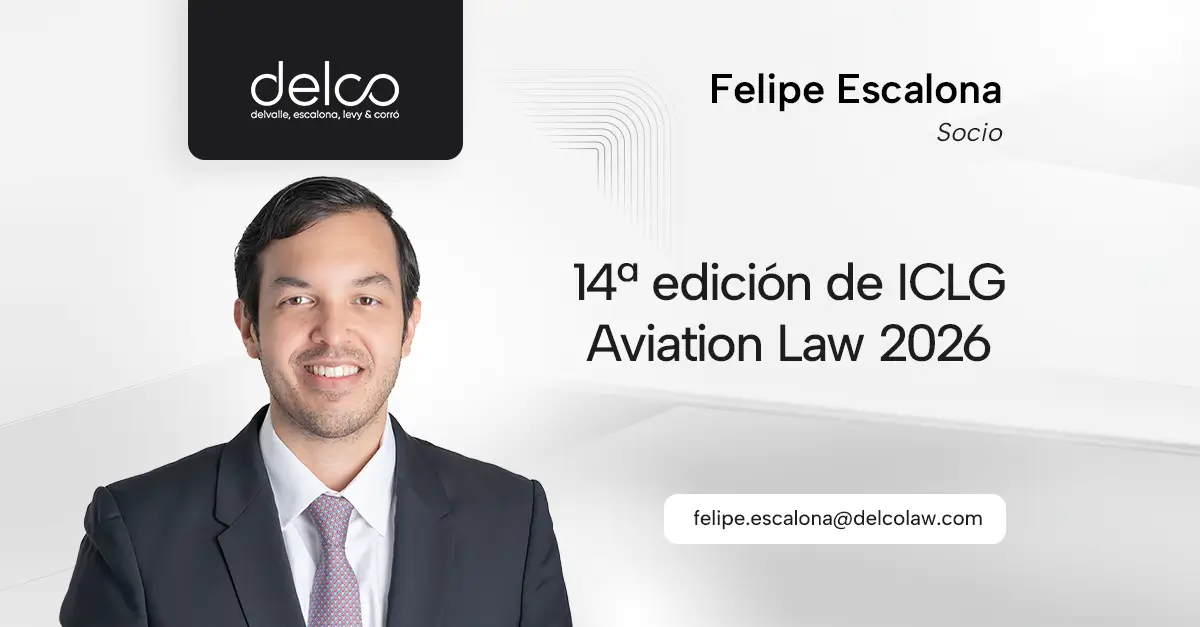
The Panamanian aviation industry continues to solidify its position as a regional leader. In the 14th edition of the International Comparative Legal Guides (ICLG) Aviation Law 2026, Felipe A. Escalona Boyd, partner at Delvalle Escalona Levy & Corró (DELCO), authored the chapter on Panama.
This contribution once again positions DELCO on the global map of aeronautical law and reaffirms Panama’s strategic role as one of the main aviation hubs in Latin America.
What is ICLG Aviation Law and why is it relevant?
ICLG Aviation Law is one of the most internationally recognized comparative legal publications. It brings together expert analysis from multiple jurisdictions, offering a detailed overview of regulation, financing, litigation, competition, consumer protection, and future trends in the industry.
Participation as an author in this guide not only implies technical recognition, but also thought leadership in a highly specialized and regulated industry.
The regulatory framework for aviation in Panama
The chapter written by Felipe Escalona describes how the Panamanian aeronautical regime is structured on three fundamental pillars:
- The Civil Aviation Law (Law 21 of 2003)
- The Civil Aviation Regulations of Panama (RACP), aligned with the ICAO Annexes
- Law 23 of 2003 on airport administration
The competent authority is the Civil Aeronautics Authority (AAC), which oversees the certification, operational safety, technical compliance and operation of airlines and aerodromes in the country.
This regulatory framework has allowed Panama to maintain high standards of security and international compliance, strengthening its position as a regional logistics and air hub.
Panama as a strategic hub
The analysis highlights Panama’s role as an international connectivity hub, driven by airport infrastructure and the policy of opening up the air market.
The Panamanian model allows foreign airlines to operate under bilateral agreements or principles of reciprocity, promoting competition and connectivity. Furthermore, the country actively participates in key international conventions such as the Montreal Convention and the Cape Town Convention, providing legal certainty for operators, lessors, and financiers.
Aircraft trading, financing and registration
One of the most relevant aspects addressed in the publication is the aeronautical registration and financing system in Panama.
The country recognizes the registration of property and encumbrances in the Aeronautical Section of the Public Registry, supplemented by the records of the Civil Aviation Authority (AAC). Furthermore, Panama is a party to the Cape Town Convention, including the adoption of Alternative A, which strengthens the protection of creditors and lessors in insolvency scenarios.
The chapter also analyzes the formalities necessary to ensure the enforceability of mortgages, lease agreements and other financial instruments, essential aspects for cross-border transactions.
Litigation and dispute resolution
The Panamanian system allows for the peaceful recovery of aircraft when there is no opposition, and provides for expedited judicial mechanisms in case of dispute. Civil courts hear disputes related to contracts, enforcement of guarantees, and liability.
Additionally, Panama recognizes and enforces foreign arbitral awards in accordance with the New York Convention, consolidating its reputation as a reliable jurisdiction for international investors.
Competition, consumer protection and trade regulation
The chapter also examines:
- The regime for reviewing economic concentrations before ACODECO
- The approval of cooperation agreements between airlines by the AAC
- Passenger data protection
- Consumer rights in the event of cancellations, delays and denied boarding
This comprehensive approach reflects a regulatory ecosystem that combines technical supervision, competition control, and end-user protection.
Looking to the future: modernization and governance
Beyond the regulatory analysis, the contribution identifies strategic areas for the development of the sector in the coming years:
- Consolidation of airport expansion and optimization of airspace.
- The need to modernize the aeronautical registration system towards a digital and centralized model.
- The institutional strengthening of the sector, with governance structures that guarantee continuity and a long-term vision.
These reflections not only describe the current state of the Panamanian regime, but also provide a strategic vision focused on competitiveness and investor confidence.
Technical leadership at the service of industry
With over 18 years of experience advising international airlines, lessors, manufacturers and financial institutions, Felipe Escalona has developed a comprehensive practice that covers the entire cycle of aeronautical operations in Panama.
His participation as an author in ICLG Aviation Law 2026 reaffirms DELCO’s commitment to the development, modernization and strengthening of the aeronautical sector, supporting local and international clients in a dynamic and highly specialized regulatory environment.
Panama and DELCO in the global conversation
The inclusion of Panama in this edition of ICLG Aviation Law not only highlights the national legal framework to the international community but also positions DELCO as a leading firm in aeronautical law in the region.
In a sector where legal certainty, regulatory predictability and technical expertise are crucial, specialized leadership makes all the difference.